How do you like them grafted apples
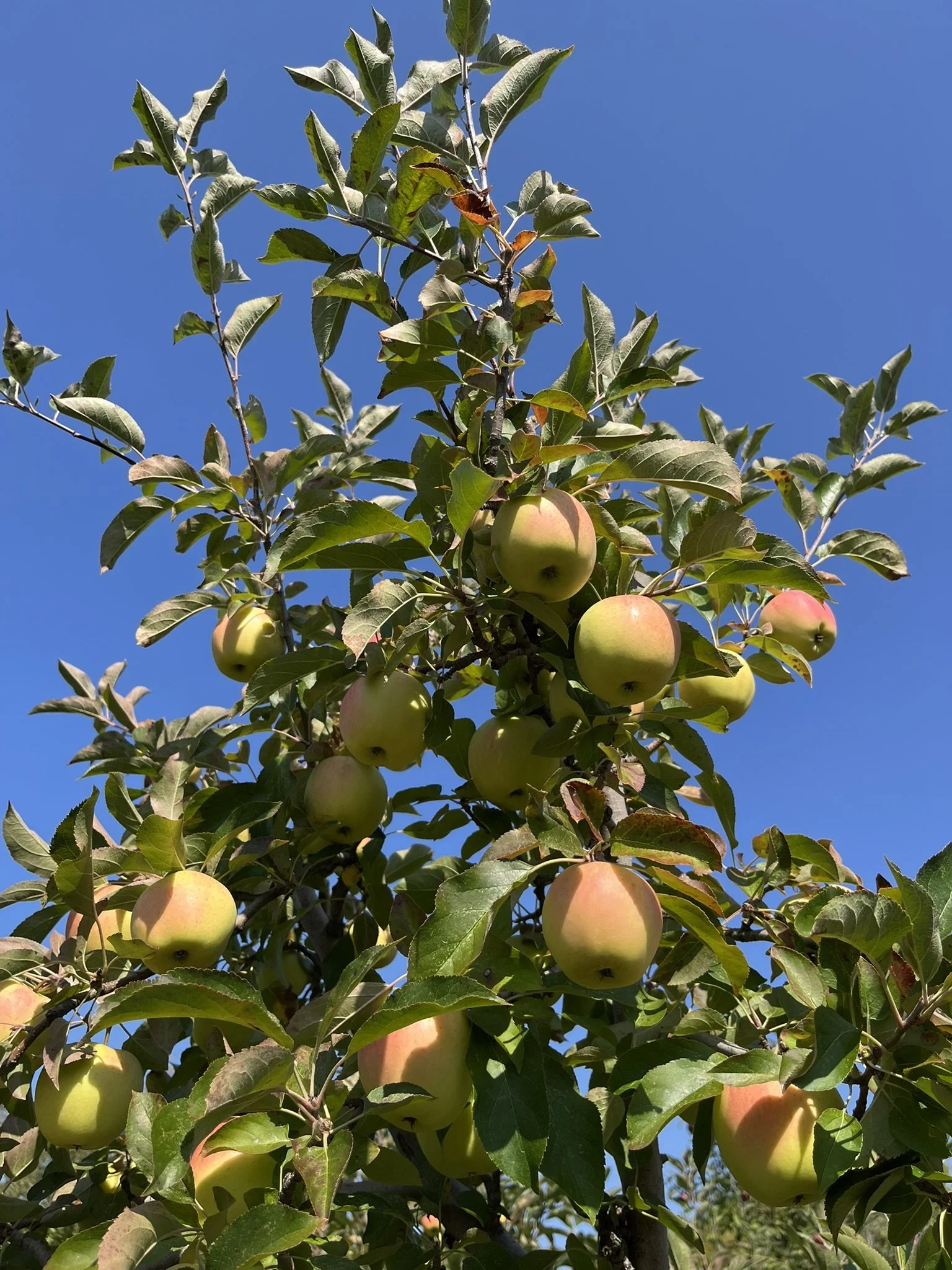
Apples have a long history of cultivation. Ancient, even. Our favorite culinary apples, the Granny Smith, McIntosh, Pink Lady and every other apple you see glistening like a waxed jewel in the bright lights of the produce department, originated from wild forests in Central Asia. Seeds from these wild apples traveled through Europe and Asia by trade routes several thousand years ago. These Central Asian apples were planted, intentionally or otherwise, crossed with native crab apples, and eventually selected for cultivated.
The challenge with apples is that they do not grow true to seed. Like us, the planted seed from your favorite Golden Delicious will have a combination of traits inherited from the tree that provided the pollen and the tree that grew the apple. It may have some of the qualities you expect from a Golden Delicious, like the low-acid sweetness of said apple, but it may be red in color or have an unexpected texture. Or the tree grown from the seed may be less disease resistant than the parent. Grafting ensures predictability.
Grafting might sound daunting, like something only for the experienced gardener or commercial farmer. That’s certainly not the case. It takes a little practice, but I found it to be well worth the effort. First, let’s go over a couple of grafting terms. A grafted tree has essentially two parts: the rootstock and the scion.
The rootstock is the part of the tree that’s anchored into the earth. It consists of roots and about 12 inches of stem or trunk. The rootstock is often from a hardy apple variety grown for its ability to adapt to a wide range of soil conditions, rather than for tasty fruit. Rootstock is also grown for predictable levels of vigor. Some rootstocks will grow dwarf apple trees, reaching only 6 to 8’. Others will grow apple trees that reach over 25’. Rootstocks will be labeled as dwarf, semi-dwarf or standard and sellers should provide expected height at maturity as well as preferred growing conditions and disease resistance. I selected semi-dwarf rootstock for my grafting project, as these are easier to maintain than a full-size tree and do not need support. Trees grown on dwarf rootstock often need support throughout their lifespan.
The scion is essentially a vegetative clone. A one-year-old branch from a known apple tree specimen. Scions are clipped from established trees in late winter. This year I gathered scions in early March, clipping long, straight, supple growth from the previous season and storing it in labeled freezer bags in the refrigerator with a slightly moist paper towel until it was time to graft.
The buds now fat with spring sap, it is a perfect time to graft. I gathered my tools. I use a sharp grafting knife, a spray bottle of isopropyl alcohol to clean my tools of sap, hand pruners, and a roll of parafilm. The parafilm can be purchased online and is a thin strip of paraffin wax on a roll. I prefer it over nylon or other plastics because it does not constrict the young tree as they swell through the season. The buds can also push through the parafilm. It is a good idea to have some potting material handy, or a damp towel to cover the roots as you’re working. They can dry out easily, especially if you are working outside in windy conditions.
Materials gathered, I took a rootstock, held it firmly in my left hand with the roots pointing away from me, and pressed my knife against the bark, ensuring at least 6 inches of trunk remained after the cut. The knife set, I pulled the rootstock away from me, creating a clean cut at approximately 60 degrees. I then made another cut, about ¼ inch deep, just above the center or pith of the rootstock. The cut on the rootstock made, I moved on to the scion.

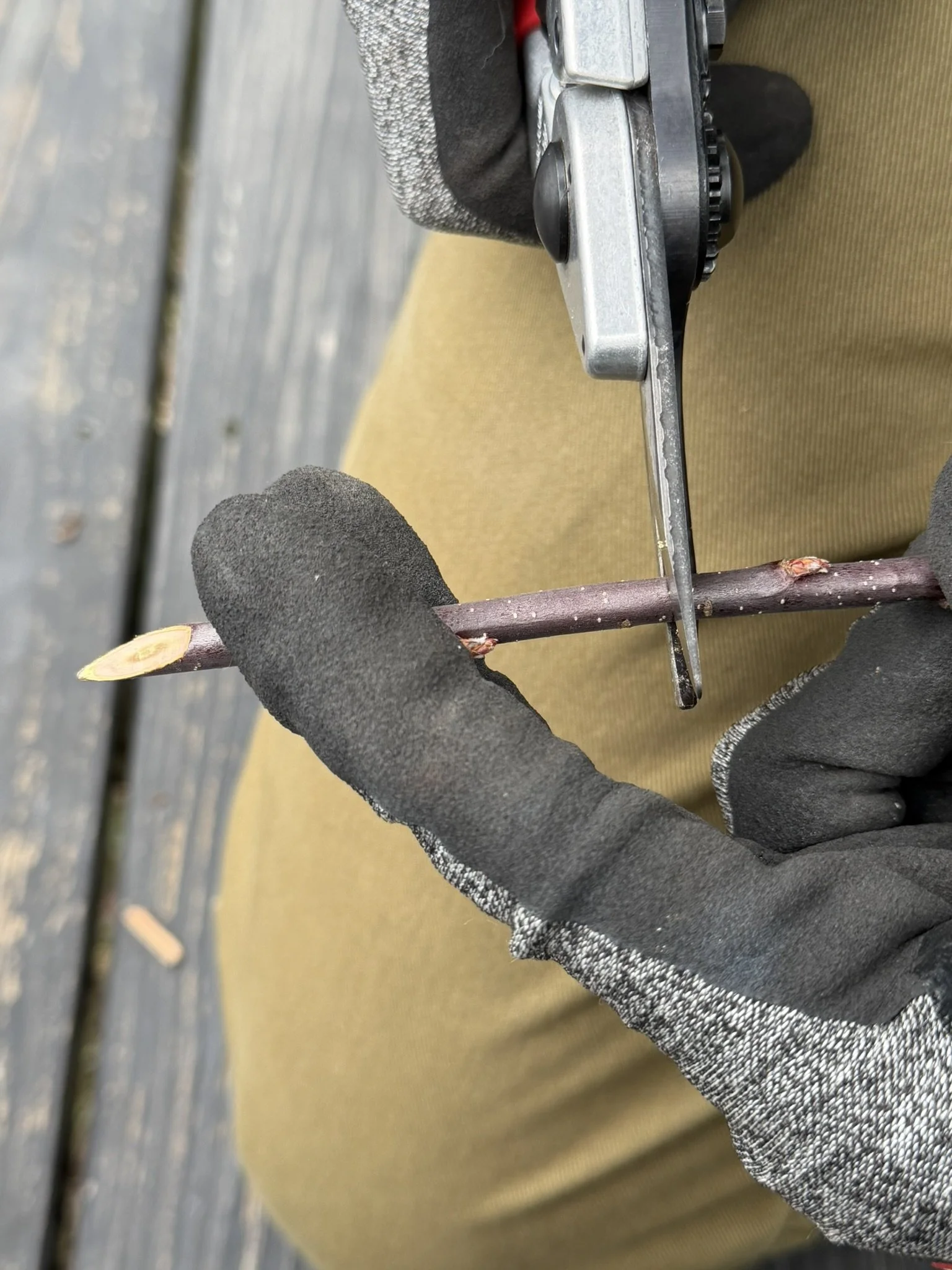

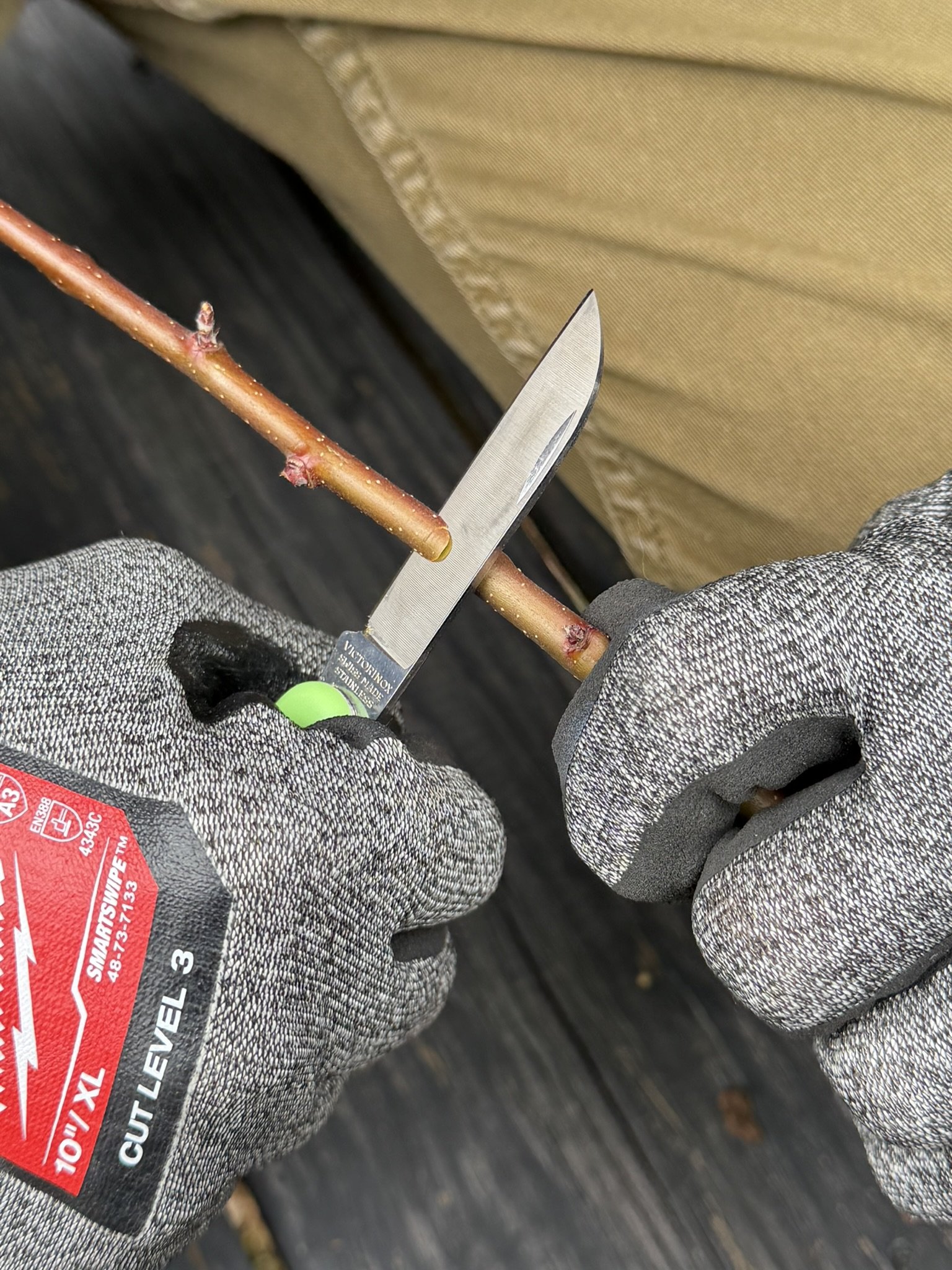
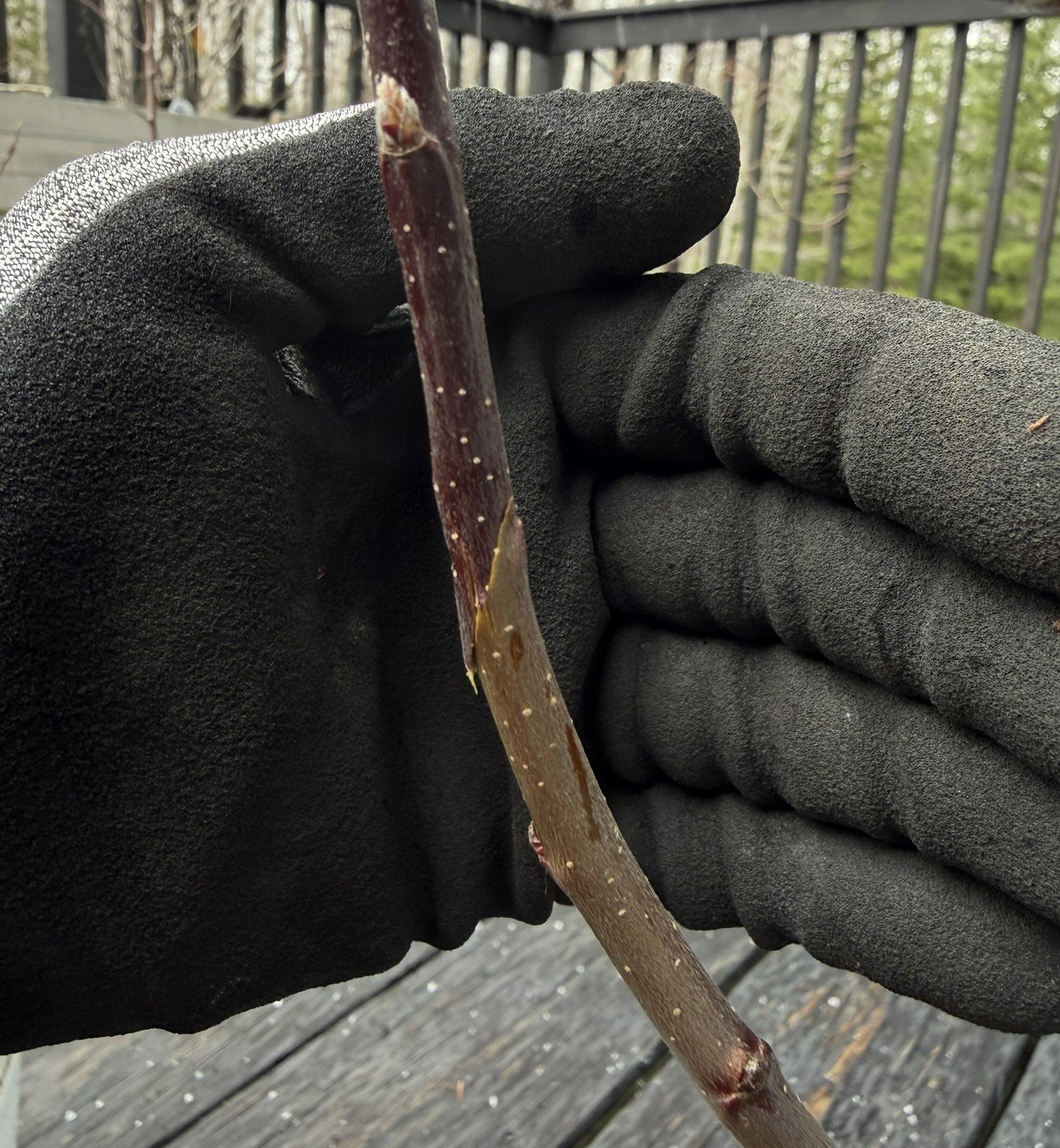
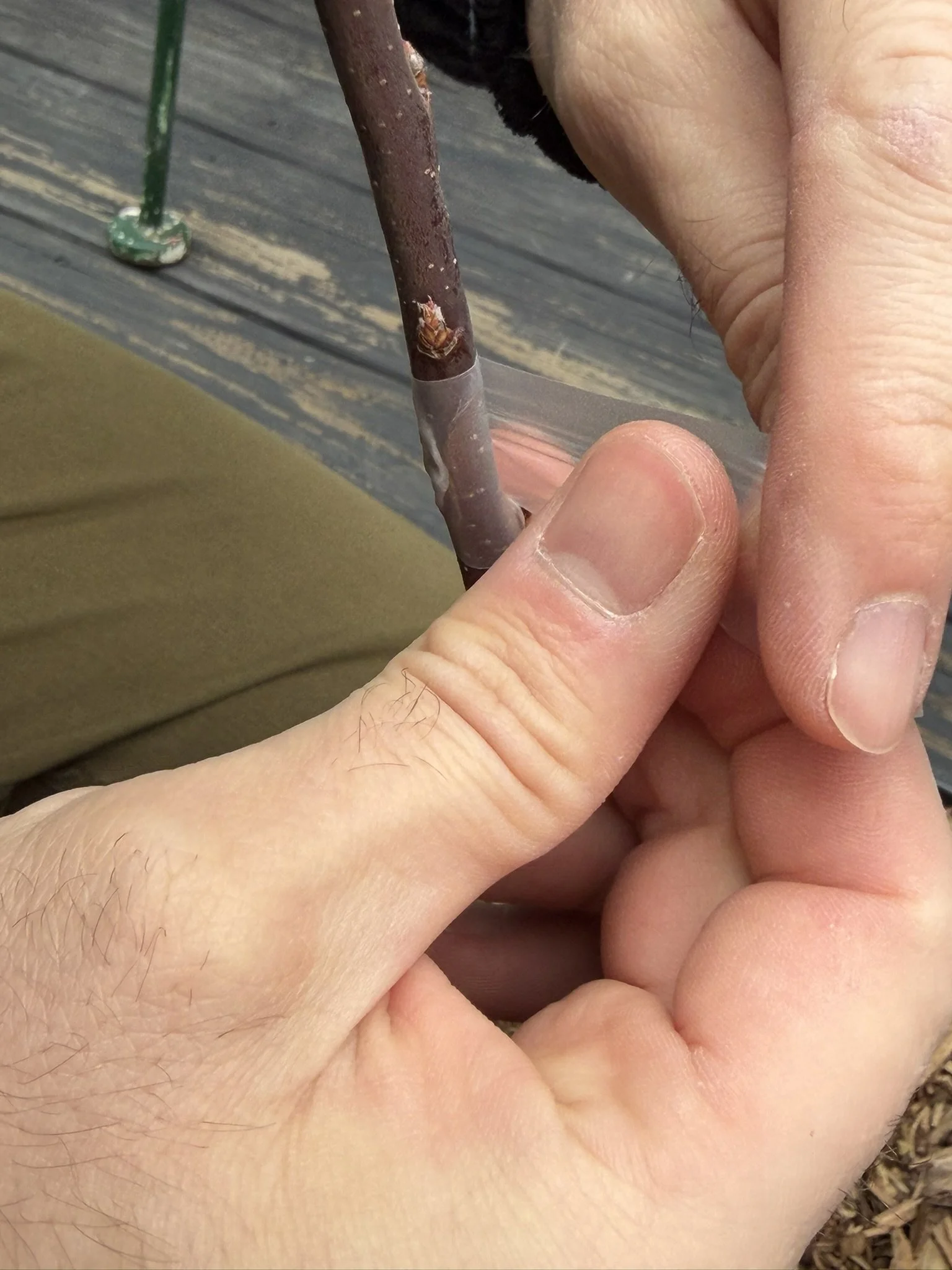
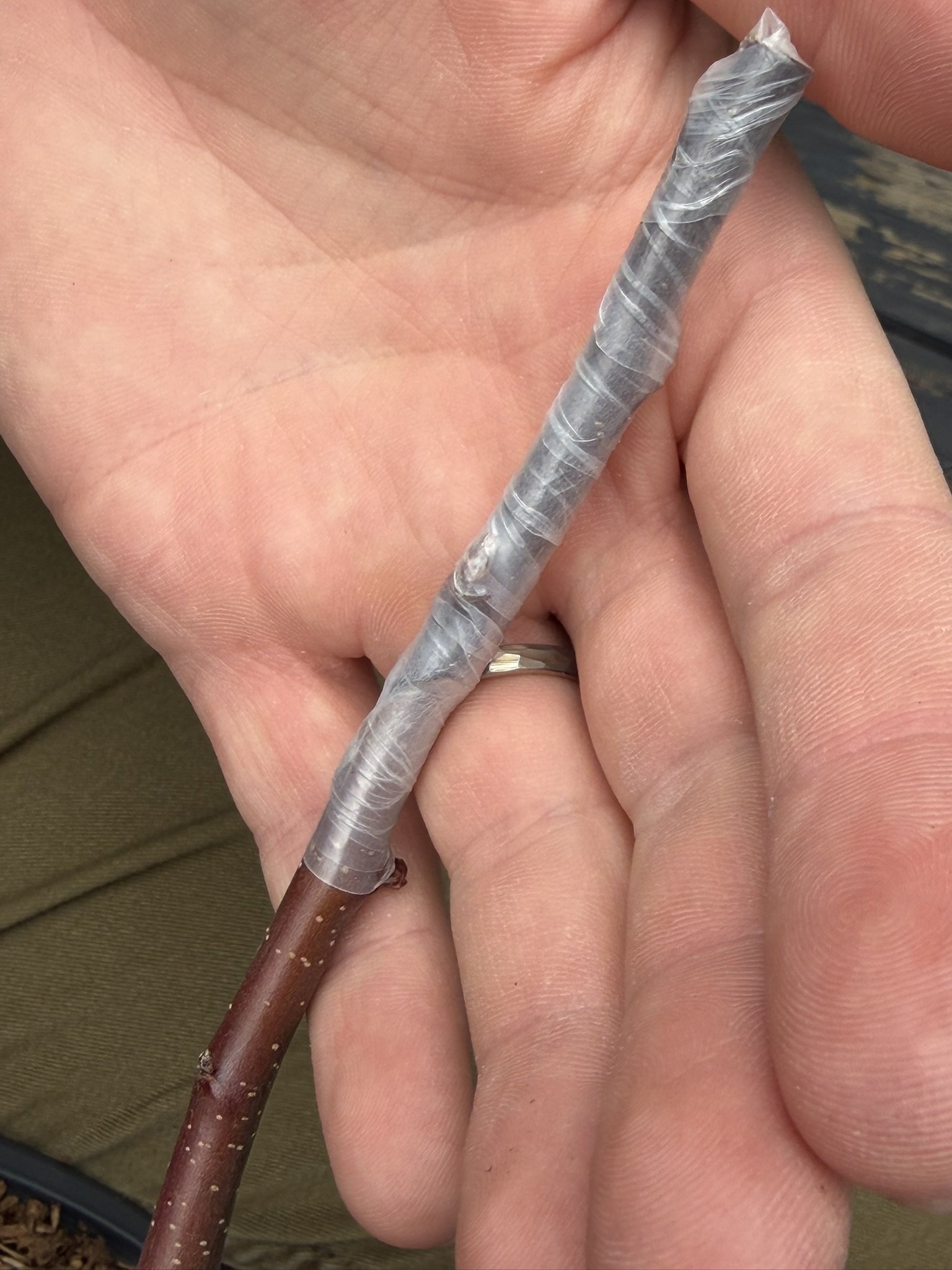

1). Cutting the scion at an angle with a grafting knife and cut-resistant gloves. 2). Clipping the end of the scion to two or three buds. 3). Cutting a one quarter inch slice to create the tongue on the scion. 4). Making a similar angled cut on the rootstock. 5). Aligning the cambium. 6). Securing the entire scion with parafilm to hold the graft firmly in place while the union heals. 7). I wrap the entire scion with parafilm to prevent the graft from drying out. The buds will push through the parafilm. 8). Finished grafts potted up and placed in a sheltered location until the following growing season. I selected a section of the scion with two buds and placed my knife at a similar angle to the rootstock cut. Again, pulling away with my left hand, I made a clean cut into the wood at about a 60-degree angle. I then made a ¼ inch-deep cut across the center, just as I did with the rootstock. Using the hand pruners, I cut above the angle leaving two buds on the bit of scion I prepared.
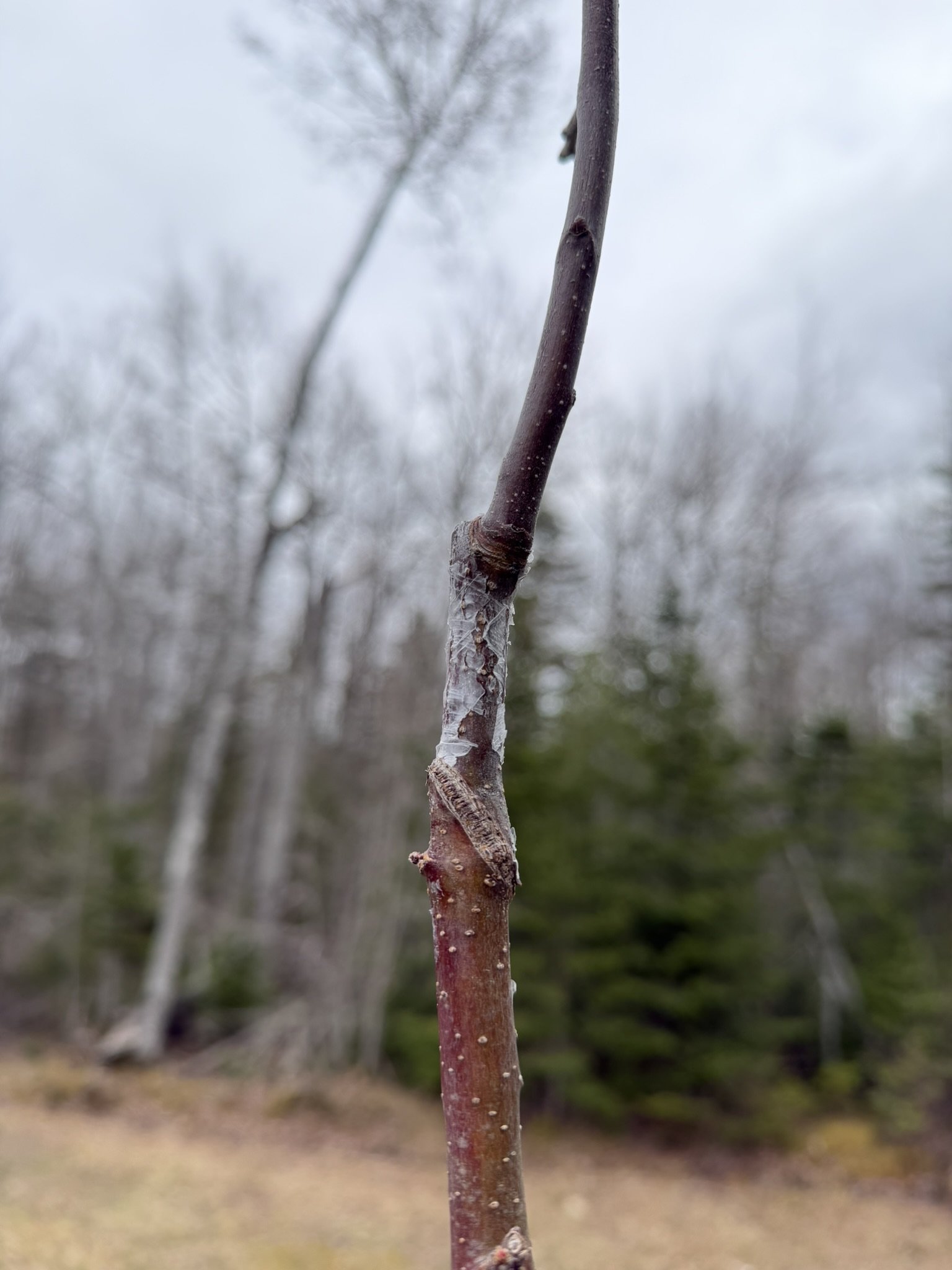
A one year old apple graft I made last spring. Notice the healed union.
This kind of graft is called whip and tongue, with the tongue part being the ¼ cut made across the angled slices of wood. To join the two, I lined up one side of the angled scion with one side of the rootstock and wedged the ¼ inch cuts together. The cambium, the living tissue of the tree, will join if the pieces are lined up on at least one side. Lined up and wedged together, I secured the two pieces of wood with parafilm. I wrapped the entire scion and about an inch of the rootstock below the graft with parafilm. This ensures that the scion will not dry out before the two pieces of wood grow together.
Secured, the apple trees can be potted up or planted in a sheltered area for a season. Within three to six weeks the two should join and buds will break through the parafilm. The following year they can be planted in their permanent location. I have about a 60-80 percent success rate. For the grafts that do not take, the rootstock has always survived. Another attempt can be made the following season.
Grafting is incredibly rewarding, and we are fortunate in Maine to have a vibrant community of apple growing enthusiasts. The Maine Organic Farmers and Gardeners Association hosts scion exchanges a couple times throughout the early spring. Rare and heritage varieties of apples and pears can often be found at these events. Grafting classes are also offered throughout the state. There are many grafting techniques and the enthusiasm for the season is infectious. Grow your own and share with friends.